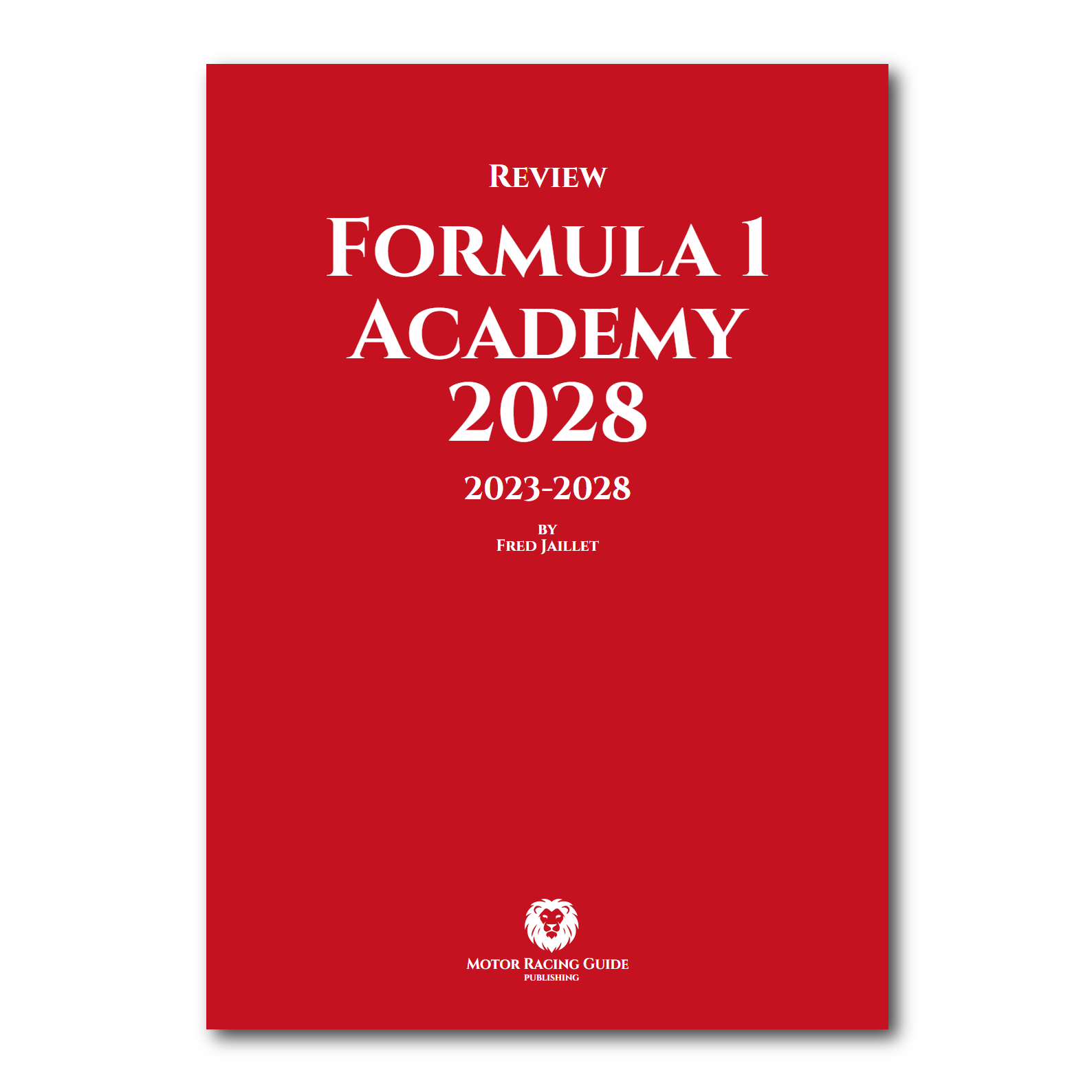
Review Formula 1 Academy 2028
Review Formula 1 Academy 2028 documents the 2028 F1 ACADEMY season session by session and brings together the results from previous seasons since the championship was created in 2023. A new reference edition following the evolution of a series that has become a major part of the international development ladder for young female drivers.
Available on 01/12/2028
Publication details




Description
F1 ACADEMY continues to develop internationally
Created in 2023, F1 ACADEMY has quickly established itself as a new stage in the international single-seater development ladder for female drivers. Designed to identify, develop and support young female talents, the series now has a regular place within Formula 1 Grand Prix weekends. Since 2024, the Wild Card programme has also provided opportunities for emerging drivers from the regions visited by the championship.
Review Formula 1 Academy 2028 documents the 2028 season in detail, session by session, while placing it within the history of the championship since its launch. The book also brings together the results from previous seasons, creating a structured archive of the drivers, teams, circuits, races and developments that have shaped the first years of F1 ACADEMY.
The opening seasons have already produced several generations of drivers. Marta García won the inaugural championship in 2023, followed by Abbi Pulling in 2024 and Doriane Pin in 2025. This succession of champions illustrates the role played by F1 ACADEMY in identifying and supporting talents aiming to progress towards higher categories.
The series has progressively strengthened its structure. The grid expanded to 18 cars in 2025 with the arrival of Hitech as the sixth team, while the Wild Card programme has developed to offer further opportunities to young drivers from the different regions visited by the championship.
The sporting format has also evolved. From 2026, selected events feature three races with the introduction of the Opening Race alongside the Reverse Grid Race and Feature Race. This provides additional competitive track time while adding another strategic dimension to the management of a race weekend.
F1 ACADEMY continues to follow a technical philosophy based on equal machinery. The 18 cars are identical and distributed among six teams, keeping driver development at the centre of the competition. Regulations normally limit drivers to two seasons, but an exemption introduced from 2027 allows certain drivers with strong development potential to compete for a third campaign. Championship winners are not eligible to return for another season.
The 2028 season therefore belongs to a period in which F1 ACADEMY is no longer simply a new championship, but an established part of the single-seater development pyramid. Its international exposure, integration into Formula 1 weekends and expanding talent identification programmes are helping to broaden the pool of female drivers able to progress towards higher levels of competition.
As with the other Reviews in the Red Books collection, this publication is not intended to replace daily sporting coverage. It is an archive: sessions, qualifying, races, drivers, teams and statistics are organised so that they can be consulted, compared and preserved over time.
Review Formula 1 Academy 2028 continues the annual archive established with the series’ first editions, allowing readers to follow, season after season, the development of a new generation of female racing drivers in international motorsport.
A new F1 ACADEMY season. Six years of history. One 2028 season in detail. An archive following the next generation of female racing drivers.